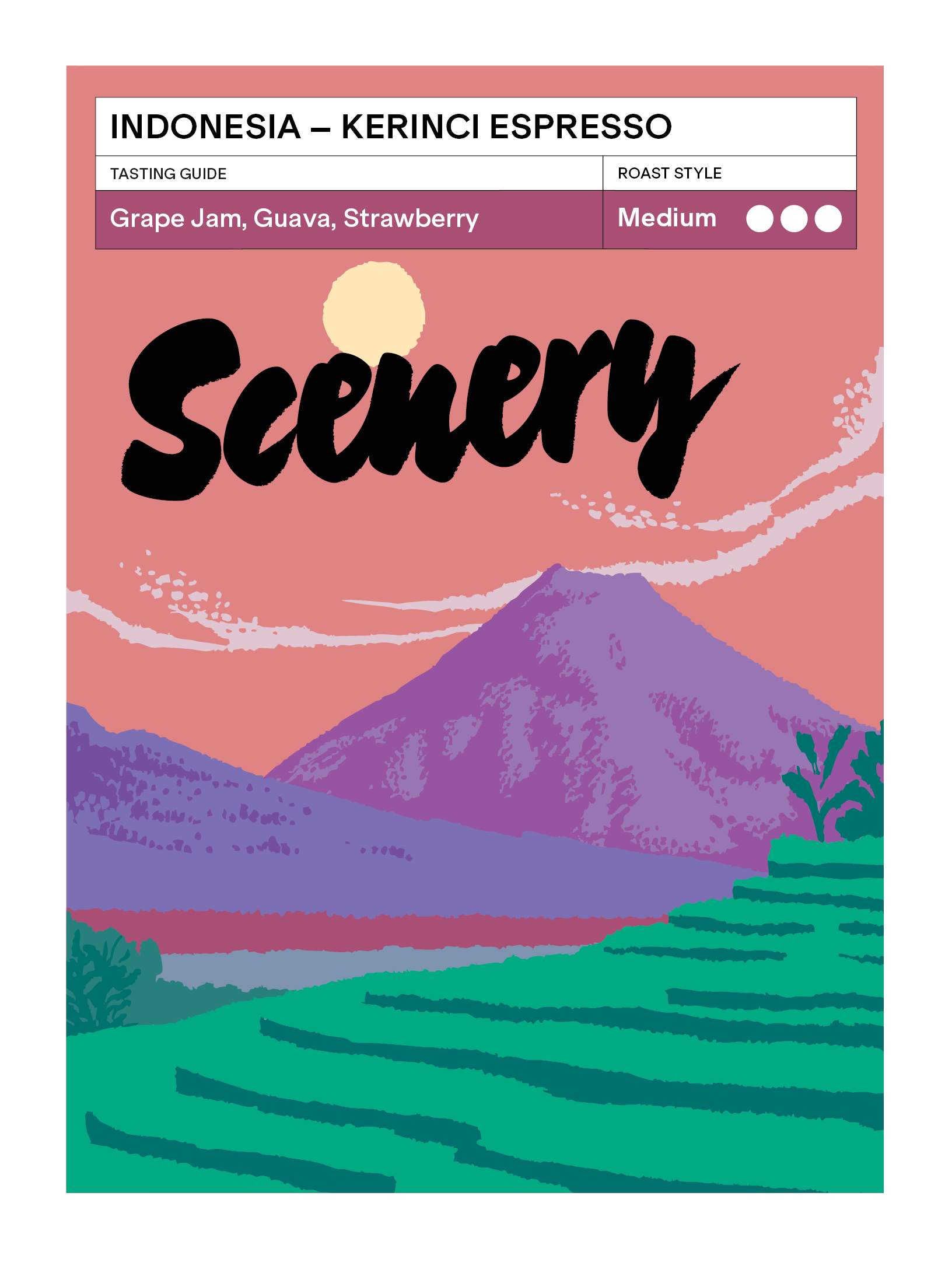
Indonesia - Kerinci Barokah
Tasting Notes
Description
Our latest espresso focused lot (selected & profiled with that brew method in mind, but by no means excluding it others!) sees a returning co-operative to the Scenery offer, for their debut run as a single origin lot. Kerinci Barokah have been at the forefront of changing the perceptions of Indonesian coffee - deploying higher intervention processing techniques as well as washed process, breaking from the old stereotype for earthy/tobacco tasting "Giling Basah" wet-hulled lots. We first featured an anoxic natural from Kerinci as part of Colourful V5, and we're delighted to bring it back for our next espresso. Founded in 2017 with 22 farmers at the foot of Mount Kerinci in Sumatra, the Koperasi Koerintji Barokah Bersama now represents over 320 coffee farmers, exporting to markets across three continents. The cooperative has fundamentally reimagined Indonesian coffee processing, moving beyond the traditional wet-hulled method through value adding higher intervention processing and controlled drying, all without losing a focus on farmer impact and environmental conservation. Under the leadership of Triyono, the co-op chairman, the cooperative won first place at the Indonesian Speciality Coffee Contest in 2017, followed by second place in 2018. Membership expanded to over 380 members organised into 24 farmer groups, including four women's groups. Each member receives technical support, shade tree seedlings, and guaranteed buyers. Individual farms range from half a hectare to two and a half hectares. The cooperative operates nine "UPH" (Unit Pengolahan Hasil) collection and processing stations. Each station functions as a washing station where cherries are purchased and processed before moving to the central mill. An agricultural technician supervises all stations to ensure standardised procedures. Wet-hulling emerged in Indonesia as a practical response to the region's high humidity. Koerintji Barokah has systematically moved away from this approach, investing in infrastructure for controlled drying that not only enables more traditional processes (such as washed process or naturals) as well as more advanced techniques. This has allowed them to offer differentiated profiles and contributed to the growth of a strong local specialty scene. Predominantly, two hybrid Arabica varieties developed by Indonesia's Coffee and Cocoa Research Institute are cultivated: Sigarar Utang (highly productive) and Andung Sari (high yields, great cup quality, but susceptible to leaf rust). Additional varieties include S-795, Ateng (a Catimor selection), and some old-stock Typica. The cooperative's market position centers on their partnership with Sucafina Specialty through the Farmgate Initiative, where coffee purchases contribute to community development projects. These include the distribution of shade tree seedlings (avocado, lamtoro, banana, eucalyptus), promoting soil health by training farmers to produce compost from coffee cherry husks, and intercropping coffee with vegetables and potatoes. This program regulates temperature, reduces evaporation, prevents soil erosion, and protects against wind damage. Kerinci Barokah first changed our perceptions on what Indonesian coffee could represent. We're stoked to keep Indonesian coffees in the line-up - arriving through the latter half of the year, these lots continue to surprise and delight us.
Origin
Purchase
Similar Beans
Based on tasting notes and processing method

Colombia - Las Margaritas Geisha | Natural
Rogue Wave Coffee


Ethiopia Ashu Syoum Anaerobic Natural
Skylark Coffee